
Why a Sanitary Cartridge Filter Decides Beer Flavour Quality, Mash Yield, and Premium Brand Positioning
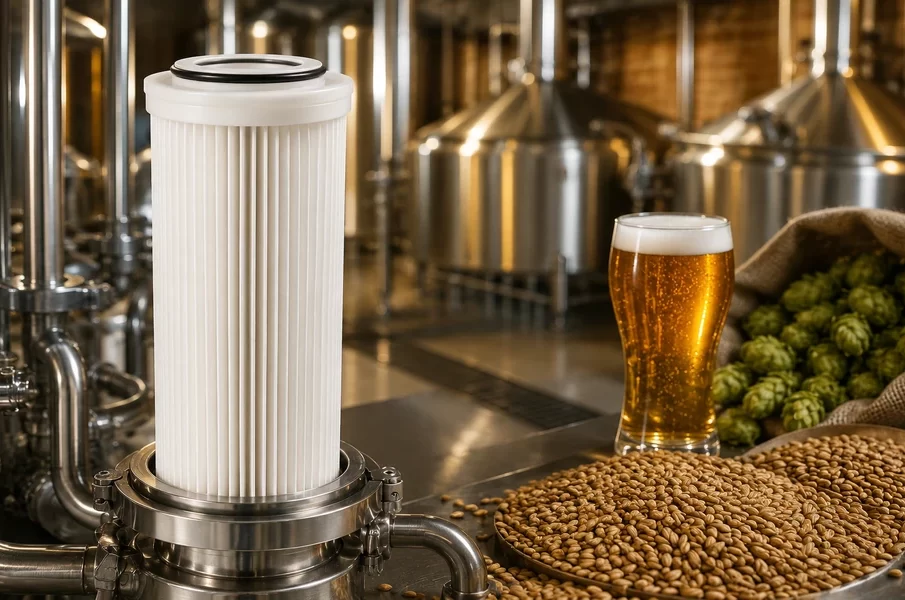
The global brewing industry is in the middle of the largest premiumisation shift in its history. From AB InBev, Heineken, Carlsberg, Asahi, and Diageo at one end to the explosion of craft breweries across India (Bira 91, Simba, Kati Patang, Bee Young, Bengaluru’s Toit, Mumbai’s Doolally), the U.S. (3,000+ craft breweries), the UK, Belgium, Germany, Australia, and the emerging GCC and African brewery scenes, every operator now competes on flavour quality, consistency, and brand-defining character. Behind every glass of beer that meets premium expectations sits a utility that determines everything: brewing liquor.
Brewing liquor – the water used in mash, sparge, and brewing operations – is the single largest ingredient in beer by volume and the most consequential by flavour impact. Iron above
0.1 mg/L produces metallic, astringent notes that experienced consumers and beer competition judges detect immediately. Chlorine above 0.1 mg/L reacts with malt phenols during mashing to produce chlorophenol compounds (TCP, medicinal flavour) – a notorious beer defect that ends careers in quality assurance. Hard water calcium carbonate above 150 mg/L inhibits mash tun enzyme activity, reducing fermentable sugar yield by 5-15% per batch. This article explains why a properly engineered Sanitary Cartridge Filter Housing has become the universal global standard for brewery brewing liquor and sparge water final polishing, and why it is now table-stakes infrastructure for every brewery targeting premium positioning.
The Hidden Economics of Brewing Liquor Quality
Three numbers explain why brewing liquor filtration deserves capital priority alongside the kettle and the fermenter, not as an afterthought.
Driver one: batch rejection from flavour defects. A craft brewery batch of 1,000 litres at premium pricing of USD 2 per litre represents USD 2,000 in product value; commercial-scale brewery batches at 10,000-50,000 litres scale linearly to USD 20,000-100,000 per batch. Flavour defects from iron contamination, chlorophenol formation, or hardness-driven enzyme inhibition trigger batch rejection at quality release – with the rejected wort dumped or downgraded to non-premium product at a 70-80% revenue write-off. For breweries supplying global beer competitions or premium retail channels (Whole Foods, Tesco Finest, Naturalia, retail beer specialty programmes), batch rejection cascades through brand positioning.
Driver two: mash yield loss from hardness-driven enzyme inhibition. Hard water above 150 mg/L CaCO₃ inhibits alpha-amylase and beta-amylase activity in the mash tun, reducing fermentable sugar extraction from malt by 5-15%. For a 100,000 hL annual brewery, a 10% mash yield loss translates to USD 600,000 to 1.5 million per year in additional malt cost – a number that bleeds through the operating budget until the brewery chemist traces the root cause back to brewing liquor quality.
Driver three: brand positioning and beer competition recognition. Major beer competitions (World Beer Cup, European Beer Star, Australian International Beer Awards) are now critical brand positioning events. A medal-winning beer commands 20-40% premium pricing and unlocks regional distribution. Flavor-defect-driven elimination at competition stage is one of the most operationally invisible but commercially consequential failures in the brewery business model – traceable in almost every case back to brewing liquor quality.
Why Generic Cartridges Fail on Brewing Liquor Service
Brewing liquor service combines four constraints that defeat any conventional industrial cartridge filtration:
• Non-food-grade element binders. Generic polypropylene cartridges use thermal binders, antioxidants (BHT), and surface treatments that contribute extractables to filtered water – trace compounds that fail food-contact testing under FDA 21 CFR, FSSAI, EU 10/2011, and equivalent jurisdictional frameworks. The engineered answer is FDA-compliant PP melt-blown media with documented extractables certification and full food-contact compliance per the destination market.
• Inability to capture sub-5-micron iron oxide. Generic 5-micron nominal cartridges achieve approximately 50% retention at 5 micron – inadequate for the sub-1-micron iron oxide that drives beer flavour defects. The engineered answer is absolute-rated media at 1-5 micron with documented sub-micron retention efficiency, plus optional staged media (5 micron pre-filter + 1 micron polisher) where brewing water iron loading is elevated.
• Industrial housing geometry is incompatible with CIP. Breweries run daily CIP cycles between every batch. Threaded NPT connections, ANSI flanges, and non-drainable internal geometry harbour residual products and create biofilm reservoirs that introduce bacterial contamination between batches. The engineered answer is sanitary tri-clamp connections, fully drainable design, and electropolished internal surfaces – the same ASME BPE design principles applied to brewing service.
• Inability to handle hot brewing water (sparge service). Sparge water in the brewing process is delivered at 70-80°C to extract residual sugars from the spent grain bed. Generic cartridges with thermal binders and standard seals degrade under sustained hot-water service. The engineered answer is high-temperature-rated PP media (or PES for ultra-stringent service) with EPDM or platinum-cured silicone seals validated for 90°C continuous operation.
Each of these failures independently degrades beer flavour quality. Their combined effect is what produces the recurring quality issues that haunt breweries relying on generic industrial filtration globally.
The FCPL Solution: Sanitary Cartridge Filter Housing for Brewery Brewing Liquor
Filter Concept’s engineered solution for industrial filtration with brewery brewing liquor and sparge water polishing is a Sanitary Cartridge Filter Housing installed downstream of the brewery water treatment train (multimedia + activated carbon + softener) and immediately upstream of the brewing liquor storage tank and sparge water heater. Every design element is matched to global brewing industry quality requirements.
SS 316L sanitary geometry. Internal surface electropolished to food-contact specification. Fully drainable design with no dead legs. Sanitary tri-clamp connections sized to brewery transfer demand. CIP-compatible without disassembly – the housing tolerates daily caustic (NaOH 2%) and acid (HNO₃ 0.5-1%) sanitation cycles in place. Hot-water service rated to 90°C continuous (sparge water service envelope).
Absolute-rated FDA-compliant PP cartridge. 1 to 5 micron absolute polypropylene melt-blown media with FDA 21 CFR 174-186 compliance, FSSAI food contact certification, EU 10/2011 conformity, and full extractables study documentation. Captures iron oxide colloids, post-softener fragments, post-carbon-filter particles, and trace SS piping corrosion products with documented retention efficiency. For commercial-scale operations supplying multiple brewing kettles, optional multi-cartridge housing configurations with 1 to 50 ms/hr flow capacity.
Brewery quality documentation pack. Each housing ships with documentation designed for direct insertion into brewery quality systems: material certificate to EN 10204-3.1, surface finish certificate, food-contact compliance declaration, extractables certificate, beer-quality validation template, and FSSC 22000 / BRCGS Food Safety alignment documentation. This is the documentation that international brewery audits (AB InBev, Heineken, Carlsberg supplier qualification) examine directly.
Pre-mash and pre-sparge configuration. Single-housing configuration for craft brewery operations (0.5-5 ms/hr). Multi-cartridge configurations for commercial brewery operations supplying multiple mash tuns and lauter tuns. Optional dosing-skid integration with activated carbon (chlorophenol prevention) and softener (hardness reduction) upstream of the polishing cartridge – the complete brewery water treatment train as a single engineering package.
Pilot brewery and commercial scaling support. FC-PDS™ selects cartridge format from your actual brewing liquor profile (iron, chlorine residual, hardness, pH) and target beer style portfolio. Pilsner production targets distinctly different water chemistry from IPA, stout, or sour fermentation – the cartridge specification supports beer style flexibility through changeover protocols rather than single-style optimisation.
FC-PDS™ specification methodology. Cartridge micron rating, element count, and changeout frequency are specified from your actual brewing water quality (post-treatment iron, residual chlorine, hardness, alkalinity), brewery throughput, and target beer style portfolio. Site-specific engineering produces the consistent brewing liquor quality that premium positioning requires.
The Bottom Line for Brewmasters, QA Heads, and Brewery Operations Managers
Brewery brewing liquor filtration is the rare engineering decision where the flavour quality case, the mash yield case, the brand positioning case, and the food safety case all align in the same direction. The cost of getting it wrong is not just a maintenance line item – it is batch rejection write-offs, mash yield loss bleeding through every operating campaign, brewing competition elimination, and – in the worst case – brand positioning damage that ends careers in brewery operations. The cost of getting it right is a fraction of one quarter’s mash yield loss.
Filter Concept has been engineering brewery filtration solutions for over twenty-three years, with installations across craft brewery, regional brewery, and commercial-scale brewing operations in 90+ countries. Customers include Indian craft brewery operations (150+ across major cities), commercial brewing operations supplying UB, AB InBev India, and Carlsberg India, brewery operations across the GCC region (where regulations permit), Southeast Asian brewing clusters, and emerging African brewing capacity. The Sanitary Cartridge Filter Housing for brewing liquor and sparge water is one of our most repeated installations – because beer flavour chemistry is universal, but the discipline of engineering food-grade housings with documented sub-1-micron retention efficiency and brewery audit documentation is rare in the global filtration market.