
Why Singapore Property Buyers Are Increasingly Prioritizing Exit Flexibility Over Maximum Upside
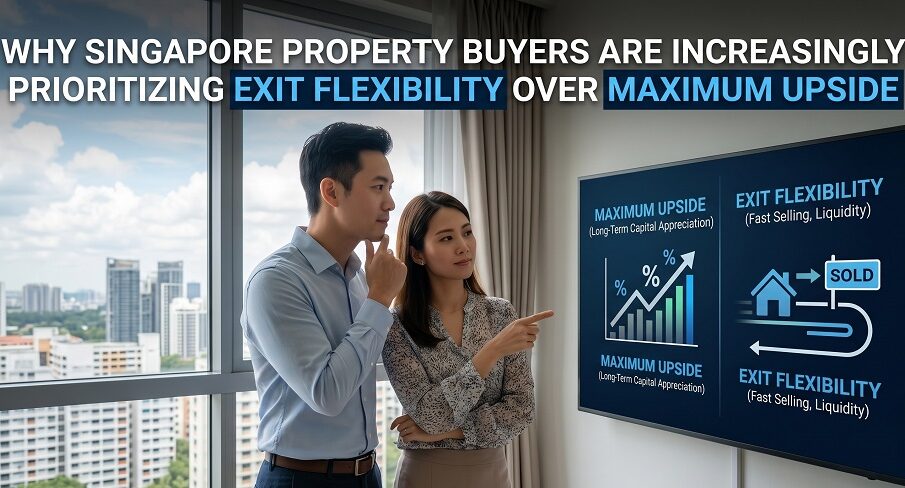
In Singapore’s residential property market, a quiet but important shift is taking place in how buyers evaluate opportunities. Instead of focusing purely on maximizing capital appreciation, many are now placing greater emphasis on exit flexibility—the ability to sell a property efficiently under different market conditions without excessive price compromise or long holding periods.
This change reflects a more mature and risk-aware buyer mindset, shaped by higher interest rates, tighter financing conditions, and a better understanding of market cycles.
The Shift from Profit Maximization to Risk-Adjusted Thinking
In earlier market cycles, many buyers were willing to stretch financially in pursuit of higher upside. The assumption was that strong market momentum would eventually compensate for entry price risk.
However, this approach has become less dominant. Today, buyers are more conscious of downside risk, holding costs, and liquidity constraints. Instead of asking “how much can this property appreciate?”, the more common question is “how easily can I exit if needed?”
This subtle shift has changed how properties are evaluated across all segments, from entry-level condos to luxury developments.
Why Exit Flexibility Has Become a Priority
Exit flexibility matters more in today’s environment because holding costs are more significant and market cycles are less forgiving. Higher interest rates mean that long holding periods carry real financial implications, even for properties with strong fundamentals.
At the same time, buyers recognize that life circumstances change—job mobility, family planning, and financial restructuring all require optionality. A property that is difficult to sell when needed becomes a liability rather than an asset.
As a result, liquidity is now treated as a core investment filter rather than a secondary consideration.
What Determines Exit Flexibility in Singapore Property
Exit flexibility is influenced by several interconnected factors rather than a single attribute. These include:
- Depth of buyer demand in the area
- Unit type standardization and appeal
- Price segmentation within the development
- Proximity to transport and lifestyle infrastructure
- Broader market perception of the location
Properties that score well across these dimensions tend to attract more consistent resale interest, even during weaker market conditions.
The Role of Buyer Pool Diversity
One of the most important drivers of exit flexibility is the diversity of the buyer pool. Developments that attract both owner-occupiers and investors tend to perform better at resale because demand is not dependent on a single segment.
Owner-occupiers provide stability during downturns, while investors add liquidity during growth phases. This balance helps smooth out transaction cycles and reduces reliance on market timing.
In contrast, highly niche developments may struggle during specific cycles if their target buyer segment temporarily weakens.
How Location Strength Supports Liquidity
Location remains one of the strongest anchors of exit flexibility. However, it is not just about centrality—it is about long-term demand sustainability.
Areas with strong transport connectivity, established schools, and mature lifestyle infrastructure tend to maintain more consistent buyer interest. These locations typically experience less dramatic demand fluctuations across cycles.
For example, established residential enclaves like Holland continue to attract steady interest due to their balanced mix of accessibility and lifestyle appeal. Developments such as Amberwood at Holland benefit from this type of stable demand environment, which supports smoother resale outcomes over time.
The Impact of Development Positioning on Resale Options
Beyond location, how a development is positioned also affects exit flexibility. Projects that are broadly aligned with mainstream demand preferences tend to be easier to resell.
This includes factors such as practical unit layouts, reasonable maintenance costs, and appeal to a wide demographic range. Overly specialized designs, while attractive to niche buyers, may reduce the size of the potential resale pool.
Developments that maintain broad appeal are generally better positioned to handle different market conditions.
Market Cycles and Timing Uncertainty
One of the reasons exit flexibility has become more important is the inherent difficulty of timing property cycles. Even experienced investors find it challenging to consistently predict peak pricing or optimal exit windows.
As a result, buyers are increasingly adopting a strategy of “prepared liquidity” rather than cycle timing. This means choosing assets that can be sold relatively easily whenever exit becomes necessary, rather than relying on perfect timing.
This approach reduces dependence on macro forecasting and increases financial flexibility.
The Balance Between Upside and Liquidity
There is often a trade-off between maximum upside potential and exit flexibility. Properties with strong speculative upside may be located in emerging areas or niche segments, but they may also carry higher liquidity risk.
Conversely, properties with strong liquidity profiles may offer more moderate appreciation but provide greater stability and lower exit friction.
Modern buyers are increasingly favoring balance over extremes, especially in a market where financial prudence is becoming more important.
Lifestyle Demand as a Stabilizing Factor
Lifestyle demand plays an increasingly important role in supporting exit flexibility. Properties that are aligned with long-term residential preferences—such as proximity to greenery, schools, and daily amenities—tend to attract more consistent demand.
This is because lifestyle-driven buyers are less sensitive to short-term market fluctuations and more focused on long-term livability.
Developments such as Thomson Reserve illustrate how lifestyle-oriented positioning can support steady demand by appealing to buyers who prioritize environment and residential comfort over speculative gains.
Conclusion: Flexibility Is Becoming the New Investment Standard
Singapore’s property market is gradually shifting toward a more risk-aware and liquidity-conscious mindset. While capital appreciation remains important, it is no longer the sole focus of buyer decision-making.
Exit flexibility has emerged as a critical evaluation criterion, reflecting a broader desire for financial optionality and reduced downside exposure.
Developments such as Thomson Reserve https://the-thomsonreserve.com.sg/ and Amberwood at Holland https://amberwood-atholland.sg/ highlight how different residential strategies can still achieve strong long-term demand when aligned with stable lifestyle and location fundamentals.
Ultimately, the most resilient property decisions today are those that balance growth potential with the ability to exit efficiently—ensuring that value is not only created on paper, but also realizable when needed.